Roof Repair FAQ

Glendale Commercial Roof Repair FAQ

Glendale Commercial Roof Repair fixes leaking flat, metal, foam, and industrial roofs on commercial buildings in Glendale, AZ, and in Peoria, Surprise, El Mirage, Sun City, Sun City West, and Youngtown.

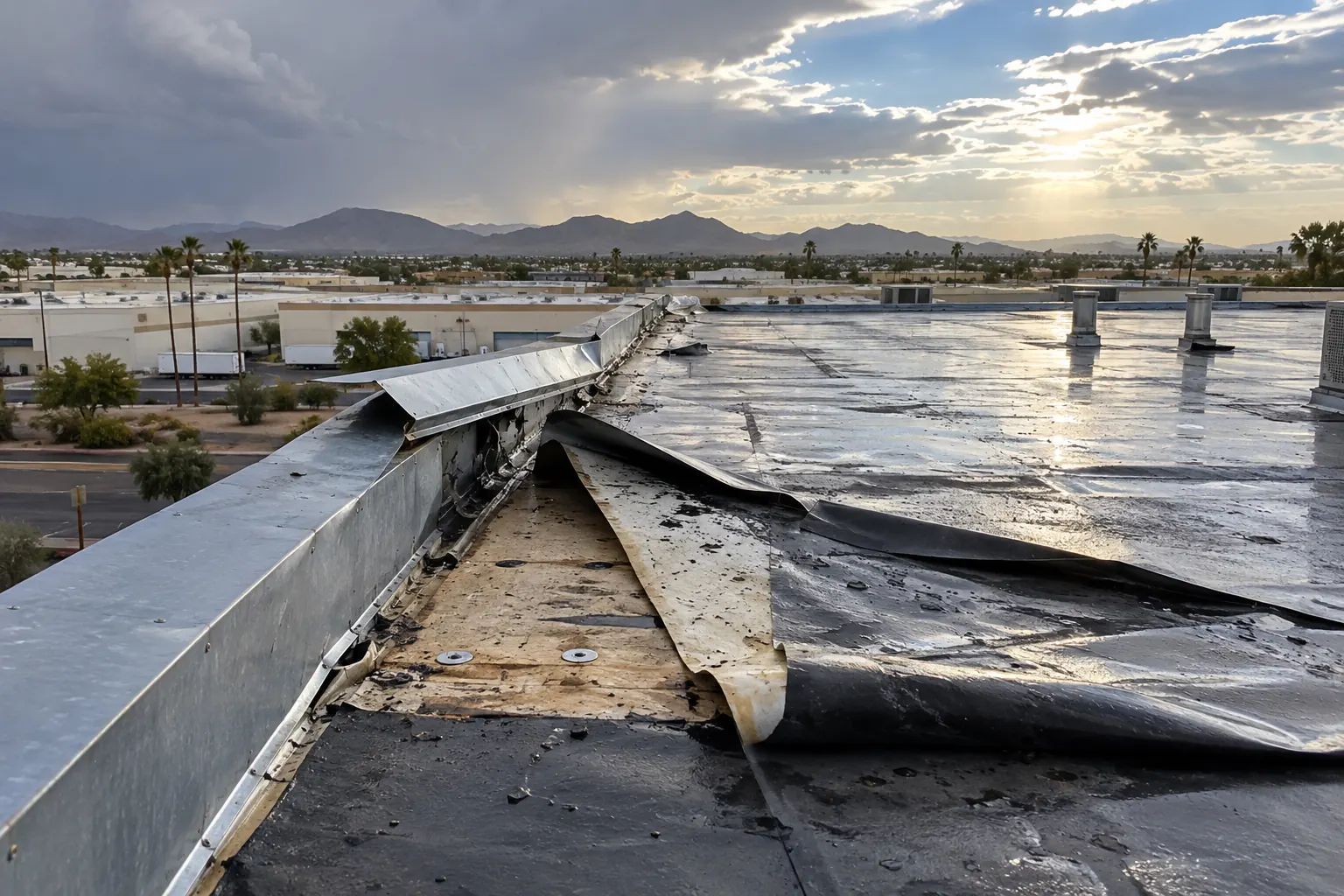
Peeled membrane and lifted edge metal on a flat roof after a monsoon storm
Jump To A Topic

Glendale Commercial Roof Repair Questions By Topic

Nineteen commercial roof repair questions answered for Glendale and nearby towns: leaks, repair methods, storms, permits, and costs.

Finding And Stopping Leaks

Where do flat commercial roofs usually leak in Glendale?

Most flat roof leaks start where the membrane joins something else, such as a seam, a drain, or a wall. On Glendale buildings, we check these spots first:

  • Seams that dried out and opened during summer heat
  • Drains and scuppers packed with monsoon dust
  • Curbs around HVAC units, where flashing pulls loose
  • Parapet walls with cracked coping or open wall flashing
  • Pipe boots and pitch pans with shrunken sealant

Why is the ceiling stain far from where my roof is leaking?

Water travels before it shows up, so the stain often sits well away from the opening. It rides along deck flutes, insulation joints, and tapered boards until it finds a gap, then drips onto the ceiling tile.

To trace it, we start above the stain and work upslope, checking every seam, curb, and penetration in that path. Moisture meters and a controlled water test on one section at a time confirm the real entry point. See how we trace and stop a commercial roof leak.

Can you stop a roof leak temporarily before a permanent repair?

Yes, a temporary patch can slow water down until a lasting repair is possible. Common short-term steps include clearing a backed-up drain or scupper, sealing an open seam or split flashing with compatible patch material, and covering a torn area so rain runs off it.

Inside, buckets and plastic sheeting protect stock and equipment. Plan to replace the stopgap with a permanent repair once the roof is dry and the cause is known.

Repairs By Roof Type

What does flat roof repair involve on a Glendale commercial building?

Flat roof repair starts with finding every failed spot on the roof, then fixing each one with materials that match the existing system. Glendale has plenty of TPO, EPDM, modified bitumen, built-up, and spray foam roofs, and each takes a different patch method.

Roof systemCommon repair
TPOClean the membrane, then heat-weld a new patch over the open seam or puncture
EPDMPrime the surface and apply seam tape or a cover strip
Modified bitumen or built-upCut out blisters, then torch or cold-apply new plies
Spray foamGrind out damaged foam, refill it, and recoat

Matching materials keeps the patch well bonded through daily heat cycles. See flat roof repair on a Glendale commercial building.

How do you repair a leaking commercial metal roof?

Most metal roof leaks come from fasteners, laps, and openings, so repairs focus there. Daily heat swings in Glendale work screws loose.

  • Backed-out fasteners get replaced with oversized screws and new washers
  • Panel laps get cleaned, resealed, and stitched tight
  • Rust bloom gets wire-brushed, treated, and primed before it eats through
  • Skylight panels that are cracked or yellowed get swapped for matching profiles

Rust or failing seams across the whole roof point toward a larger restoration. See how we repair a leaking commercial metal roof.

Can you repair an industrial roof without stopping production?

Usually, yes. Industrial roof repair in Glendale often happens around running equipment, so we plan the work with your plant or facility manager first.

  • Exhaust fans and process vents get shut down or shielded during work
  • Oils and residue around vents get cleaned off so patches bond
  • Repair zones get scheduled around shift changes
  • Walkway pads go down along the routes maintenance staff use

Grease-damaged membrane near an exhaust outlet often needs a more resistant material. See industrial roof repair around running equipment.

How do you fix a spray foam roof with bird damage or exposed foam?

Small foam damage is a quick fix when it's caught early. Birds peck holes in foam roofs, and once the coating is gone, the sun breaks down the foam surface until it turns brown and crumbly. Repairs involve cutting out damaged foam, filling the cavity with new foam or sealant, and recoating the patch to match the surrounding roof.

Large areas of exposed or water-soaked foam need a bigger section removed before the roof is recoated.

Repair Or Replace, Cost, And Upkeep

When does a commercial roof need replacement instead of repair?

It's time to look at replacement once water has reached the deck or soaked much of the insulation. Wet insulation under a small area can be cut out and replaced during a repair.

Wet insulation across large areas, a rusted or soft deck, or a membrane that cracks when folded are harder to fix in pieces. Age matters too. On a roof near the end of its service life that leaks in several places, each new patch buys less time.

How long does a commercial roof repair last?

That depends on the roof around the patch. A heat-welded TPO patch on a membrane with plenty of life left can last as long as the surrounding roof.

A patch on a brittle, shrinking membrane holds only until the next weak seam opens nearby. Workmanship, drainage, foot traffic around HVAC curbs, and ponding rings that sit on the repair all affect how long it stays tight. Regular inspections catch failing patches early.

What affects the cost of a commercial roof repair?

The size of the damage and how hard it is to reach set most of the cost.

  • Roof system and the materials needed to match it
  • Number of leak points, such as open seams or split flashings
  • Wet insulation that needs replacing
  • Access, such as roof height, hatch location, and lift needs
  • Equipment around curbs or skylights
  • Timing, if work happens at night or around production

An inspection shows which apply to your building.

How often should a commercial roof be inspected in the West Valley?

Twice a year, plus a check after any major storm. A spring visit before monsoon season and a fall visit after it catch most problems while they are still small. Routine upkeep covers:

  • Pulling dust and debris out of drains and scuppers
  • Checking sealant at pipe boots and curb flashings for cracks
  • Tightening backed-out fasteners on metal panels
  • Filling peck holes and thin spots on foam
  • Marking where ponding rings form after rain
Before You Call

Still Have A Roof Question?

Call and ask. A few details about the roof help us give a straight answer.

Have Ready
  • The property address
  • Roof type, if known
  • What you're seeing inside or on the roof

Heat, Monsoon, And Storms

How does Glendale's climate damage commercial roofs?

Heat, UV, and monsoon storms do most of the damage. Summer highs regularly pass 100°F, and the swing from a hot afternoon to a cooler night stretches seams, loosens metal fasteners, and dries out sealant at curbs.

The National Weather Service sets Arizona's monsoon season at June 15 through September 30. Those storms push dust into drains, lift loose edge metal, and drop heavy rain on weak spots that formed during the dry months.

What should I do after storm or wind damage to my commercial roof?

Document the damage first, then call your insurer before making permanent repairs. The Arizona Department of Insurance advises taking photos and video and keeping every repair receipt.

Short-term work to keep more water out is reasonable once the damage is recorded. We photograph lifted edges, torn flashing, hail marks, and debris punctures on the roof, and you should photograph ceiling stains and wet stock inside. Check any contractor's license with the Arizona Registrar of Contractors.

Permits, Taxes, And Utilities

Do I need a permit for commercial roof repair in Glendale or nearby towns?

Permit needs turn on the scope of work and on which office has jurisdiction. Patching seams and flashings is handled differently from tearing off a roof section or changing rooftop equipment. Some properties with a Glendale mailing address sit outside city limits, so we confirm the parcel's jurisdiction first.

LocationWho issues permitsWhere to check
GlendaleCity of Glendale Building SafetyGlendale building permits
PeoriaCity of Peoria Building DevelopmentPeoria Development Services Portal
SurpriseCity of Surprise Community DevelopmentSurprise permits and inspections
El MirageCity of El MirageCall the city's permit center
YoungtownTown of Youngtown Community DevelopmentYoungtown permits and plan review
Sun City (unincorporated)Maricopa County Planning and DevelopmentMaricopa County Building Services
Sun City West (unincorporated)Maricopa County Planning and DevelopmentMaricopa County Building Services

Does historic review affect roof repairs in downtown Glendale?

Only for some buildings, and mostly for work visible from the street. Glendale has a Historic Preservation Commission, a local historic register, and a district plan for Catlin Court near downtown.

Like-for-like repairs to a low-slope roof hidden behind a parapet rarely change how a building looks. Replacing visible sloped roofing, metal trim, or parapet caps on a listed building is different, so check with the city's Historic Preservation staff before ordering materials.

Can commercial roof repair costs qualify for Section 179?

Yes, when the work counts as a roof improvement on an existing nonresidential building. Under IRS Publication 946, the 2026 deduction limit is $2,560,000, and it starts phasing down once qualifying purchases for the year pass $4,090,000.

Apartment buildings and other residential rental property fall outside the rule. Smaller jobs, such as resealing a few seams or flashings, are sometimes handled as an ordinary repair expense instead, so ask your CPA how to treat each project.

Do APS or SRP offer incentives for roof repairs?

Incentives tied to roofs usually apply to cool-roof products on new or replaced sections, and programs change from year to year.

Parts of the Glendale area get power from APS and other parts from SRP, and the line between them ignores city limits, so your electric bill shows which applies. Before replacing a large section of membrane, check your utility's current business programs and look up the product in the Cool Roof Rating Council directory.

Areas And Getting Started

What areas do you serve?

Glendale, from warehouse roofs along Loop 101 to parapet-walled storefronts downtown, plus:

  • Peoria, where permits run through the online Development Services Portal
  • Surprise, where City Community Development handles roof inspections
  • El Mirage, where we call the permit center to confirm scope
  • Unincorporated Sun City, whose recreation center roofs fall under Maricopa County permits
  • Sun City West, where community roof-color rules can add an approval step
  • Youngtown, the smallest town here, with plan review by its Community Development office

How do I get started?

Call us or request a free estimate to set up a free roof inspection. A technician walks the roof and checks:

  • Seams, laps, and fasteners for openings
  • Flashings at parapets, curbs, pipes, and skylights
  • Drains and scuppers, plus any ponding rings
  • Insulation moisture near leak areas
  • Interior ceiling stains matched to spots on the roof

Findings are explained in plain words: what needs repair now and what can wait.

Next Step

Ask About Your Own Roof

Call or request a free estimate, and we'll answer your questions on the roof itself.

Call (623) 310-0166